
Web Archive · tui3.com
Several Chinese personal websites I was part of between 1999 and 2007, rebuilt in full from server archives into a static site, preserved forever
What it is
tui3.com takes several Chinese personal websites I was part of between 1999 and 2007 and rebuilds them in full into a static site, preserved forever, from server archives + Wayback fragments. The content keeps its original look, encodings are uniformly converted to UTF-8, private information such as email addresses is hidden, and it depends on no backend.
Included (5 sites)
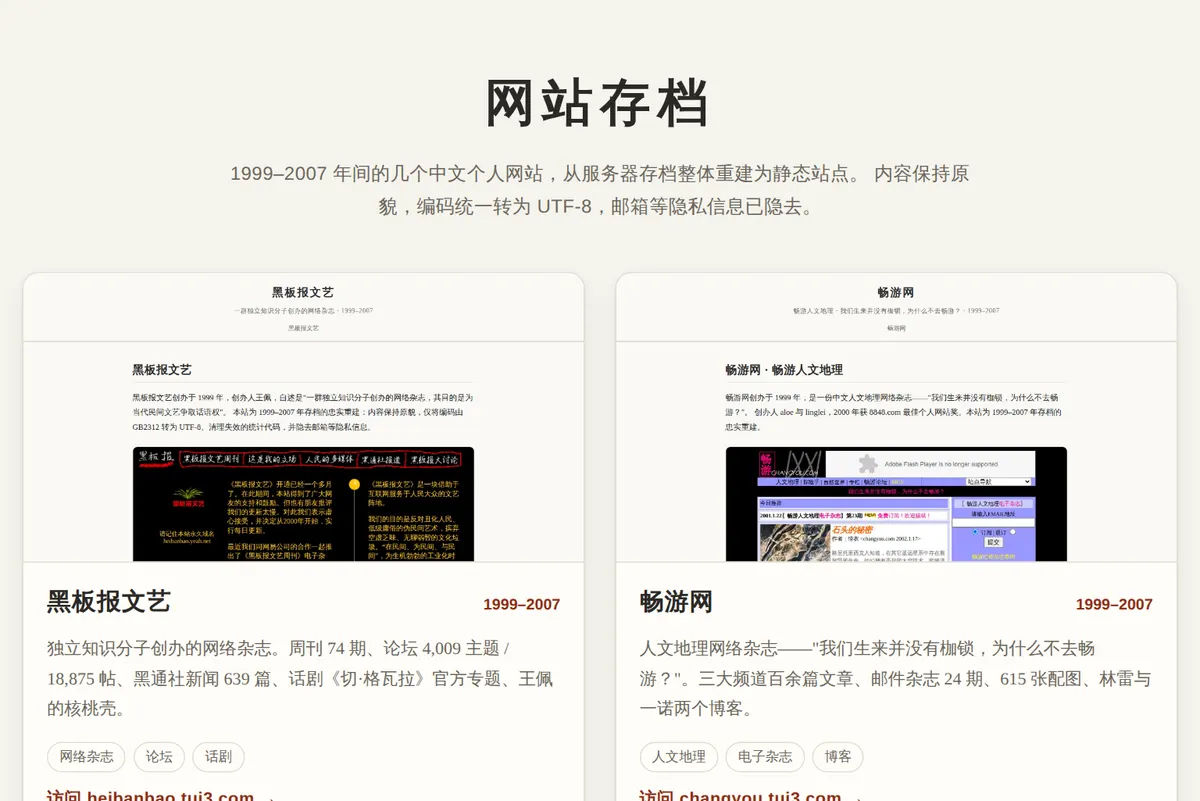
- Heibanbao Literary (1999–2007) — an online magazine founded by independent intellectuals. 74 weekly issues, a forum with 4,009 topics / 18,875 posts, 639 Heibanbao News articles, an official feature on the play Che Guevara, and Wang Pei’s Walnut Shell. →
heibanbao.tui3.com - Changyou (1999–2007) — an online magazine of humanistic geography: “We are born without shackles, so why not roam free?” Over a hundred articles across three channels, 24 issues of the email magazine, 615 illustrations, and two blogs by Lin Lei and Yinuo. →
changyou.tui3.com - On the Road (2007) — my personal blog (Zhang Lu’s Wanderings). 19 articles, the Huaxi Village dispatches series, and an interview with Vint Cerf, a father of the internet. →
zhanglu.tui3.com - Shuo3 · Tech TV (2007) — a tech video podcast by Le Yi and me. 11 posts recovered from Wayback, with 14 episode videos archived on the YouTube channel @shuo3. →
shuo3.tui3.com - Sofaee / New Marketing Lab (2007) — a tech Digg-style site later rebuilt into a marketing-news portal. 8 posts recovered from Wayback, plus archived sections and a fingerprint of 103 tags. →
sofaee.tui3.com
Why build it
Much of the early Chinese internet is quietly disappearing. These are sites I built in my twenties, and rather than let them rot on old servers and in Wayback fragments, it seemed better to rebuild them in full into a static site that depends on no backend and can be hosted forever—leaving an archive for that era of the internet, and for myself.
Putting it here is a way of saying: before building those “traceable, reviewable” AI products, I also made a few things purely out of love.