
MBA Brand
Turn brand influence into a monitorable / scorable / reviewable intelligent asset—43-juror deliberation with sentiment-driven versioned re-audits
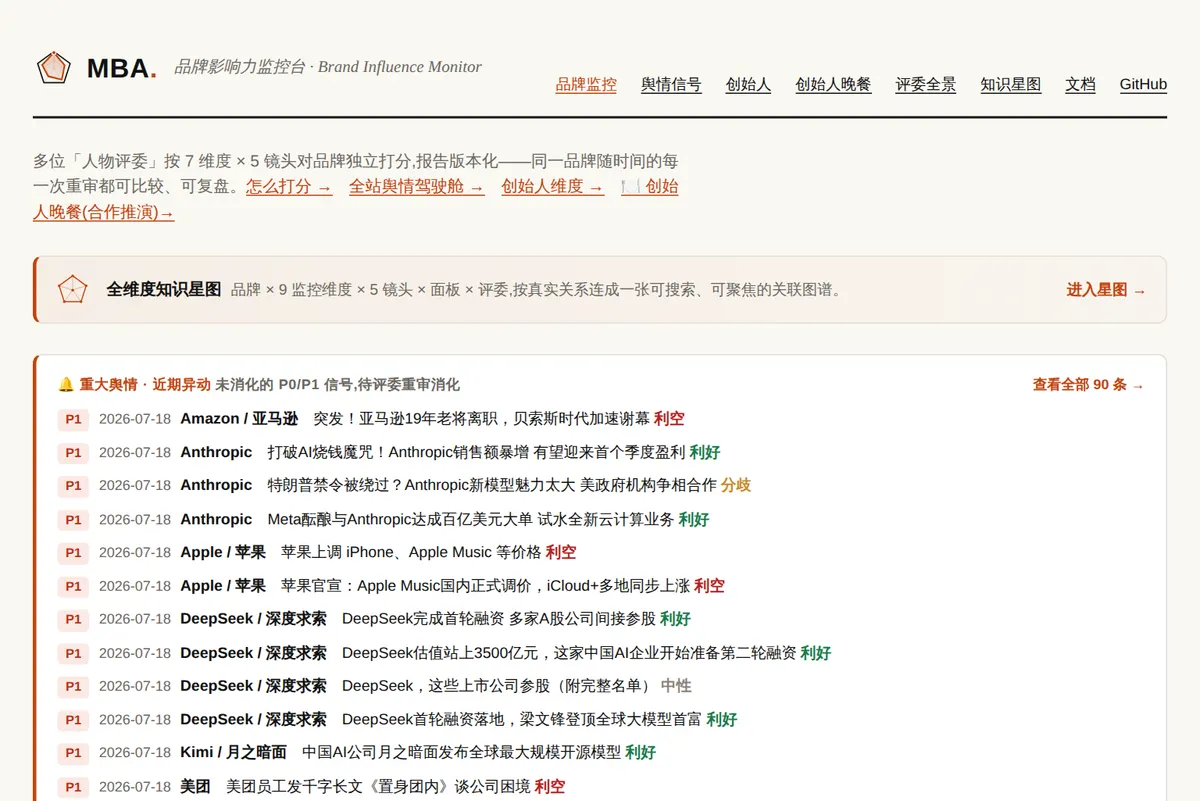
What it is
A brand-judgment pipeline built on a Claude Skill. Give it a brand name and it runs a 7-dimension parallel investigation, a Lead juror synthesis, then has a panel of “persona jurors” (Fu Sheng / Steve Jobs / Zhang Yiming / Musk, and others) score independently across 5 lenses using their own mental models, finally producing a versioned Markdown + HTML report:
- A 5-dimension radar chart (originality / category naming / leverage quality / identity consistency / authentic signal)
- A juror-dissent heatmap—which conclusion drew the most disagreement
- An influence-construction diagram—how the brand asset was built up
- 30 / 90 / 365-day attribution checkpoints, so that on later review you can attribute back to a specific evidence chain
- 90-day actionable recommendations
It started as a single skill and is now a continuously running brand-monitoring dashboard online (mbabrand.com), already monitoring 24 brands, with NVIDIA at the top on 8.88.
Recent progress
- Upgraded from “monitoring” to a “relationship universe” (v0.5): brand + founder + industry + portfolio, all four layers connected. Each brand links to its founder, founders can be seated at a “founders’ dinner” to war-game collaboration, and brands are categorized into 6 major industries and filterable on the homepage.
- Seven global tech giants added at once: NVIDIA / Apple / Google / Microsoft / Amazon / Huawei / DeepSeek, each with a full audit report; monitoring scale expanded from 15 to 24.
- The full Brand Watch sentiment-monitoring chain landed: event collection → trigger-rule evaluation → EVOLUTION automatic re-audit, where watch only suggests and never changes a score; paired with a sentiment cockpit dashboard + Feishu L1/L2/L3 tiered alerts.
- A full-dimension knowledge starmap: a pure-SVG constellation chart laying out the 184 real relationship edges across 5 lenses × 9 dimensions × brands × 10 panels × 43 jurors; each brand also has its own ego starmap.
- Released a standalone MCP server (
npx -y mba-mcp-server): 16 tools (8 core audit + 6 evolution tracking + 2 sentiment), pluggable into any MCP agent such as Claude Desktop / Cursor; incremental reruns cut the cost of an evolution audit from ~$3 to ~$0.4 per run.
Why build it
Judging brand influence has long relied on “a feeling.” Two common failure modes:
- Single-perspective bias: ask one thought leader, and their blind spot becomes yours.
- Conclusions can’t be attributed: you make a gut call that “this brand is pretty strong,” the numbers crater half a year later, and you don’t know which step was wrong.
Decomposing the judgment into multiple dimensions × 43 jurors with distinct mental models × 5 scoring lenses lets every conclusion trace back to evidence. Half a year later, whether a juror misjudged, the evidence was incomplete, or the world changed is plain to see. The core stance is anti-fabrication: cite only public first-hand sources, mark what can’t be obtained as N/A instead of inventing it, and verbatim-check juror citations through a hard CI gate.
How you can use it
Quick read (3 minutes):
/mba <brand> --quick --no-judgesUses only WebSearch + WebFetch—validate the pipeline before adding weight.
Full deliberation (30 minutes):
/mba <brand>Convenes the default 5 jurors, or use --panel <name> / --industry <name> to swap in an industry juror panel (automotive / education / consumer, etc.—10 panels in all).
Consume it as a service: mount npx -y mba-mcp-server@latest into any MCP agent, or read the site’s /api/*.json directly.
Best for: founders deciding brand direction, brand / growth teams doing PMF reviews, investors doing due diligence and sentiment tracking, and “objection rehearsals” before an AI product launch.